
Bosque Projected and Actual Release
A projected release date is TDCJ's estimate of when a person may leave state custody if no earlier parole action changes the outcome. TDCJ defines it as a calculated date based on the person's time credits, sentence, and release rules. It is not a promise. The maximum sentence date is another field, marking sentence expiration as computed by the agency. A parole eligibility or review date answers yet another question: when a case may be considered, not when the gate will open.
An actual release depends on final authorization and processing. For a Bosque County Jail booking, the sheriff's release entry supplies the operational date and time. The related court docket can show a bond order, dismissal, judgment, jail credit, or commitment, but it may not show the moment the jail completed discharge. For TDCJ, Review and Release Processing verifies an approved plan and issues a release certificate. The certificate, not a favorable vote alone, is key proof of the authorized state release.
Locate a Bosque Release Date
First determine whether the person is in the Bosque County Jail, a TDCJ unit, another county, or federal custody. These systems do not share one universal calculator. A roster absence also does not identify the destination. Use a booking or court transfer entry before switching systems.
- For current Bosque jail custody, ask Detention & Booking about bond, holds, judgment, jail credit, and release authorization.
- Ask the sentencing clerk for the judgment and any stated credit for time already served.
- For current TDCJ custody, search by name, TDCJ number, or SID number and open the official result.
- Read projected release, maximum sentence, unit, offense, sentence, and parole-review fields together.
- If the person no longer appears online, use TDCJ email, telephone, or a public-information request.
- For an approved parole or mandatory-supervision case, seek post-approval status and the release certificate.
The Bosque County release-record guide covers the county booking and court path in more detail. Detention & Booking is listed at 254-435-9966. A written request should identify the person, booking, and date range, then ask for the release date, time, reason, destination, and any transfer notation.
TDCJ Bosque Release Date Fields
The TDCJ online search serves current state prisoners. Search inputs include last name, first name, TDCJ number, and SID number, with race and gender filters. The returned information can join sentence data with release and parole fields. Read the source labels exactly.
| Field | What it answers |
|---|---|
| Projected release date | The agency's current calculated estimate, subject to change. |
| Maximum sentence date | The computed sentence-expiration point, not necessarily the expected exit date. |
| Parole eligibility or review | When review may occur or its status, not a guaranteed release. |
| Unit or location | Where TDCJ currently reports the person. |
| Offense and sentence | The conviction and term used in the state computation. |
| TDCJ or SID number | Identifiers used to distinguish the person and request more information. |
The online dataset does not provide a complete historical released-person search. TDCJ says its email information service can supply current and prior incarceration, offense, county, court, location, and projected-release information. Provide the full name and seven-digit TDCJ number. If that number is unknown, provide an exact birth date or approximate age and county of conviction. The service is free.
TDCJ telephone information is another official channel when the online form does not answer the question. Have the identifying number and full name ready, then ask which date field the representative is describing. A projected release, maximum sentence, parole review, and post-approval release status are not interchangeable. Record the response date because a later sentence or custody event may change the information.
TDCJ's email-information page shown here states the projected-release definition and describes the alternate request route.
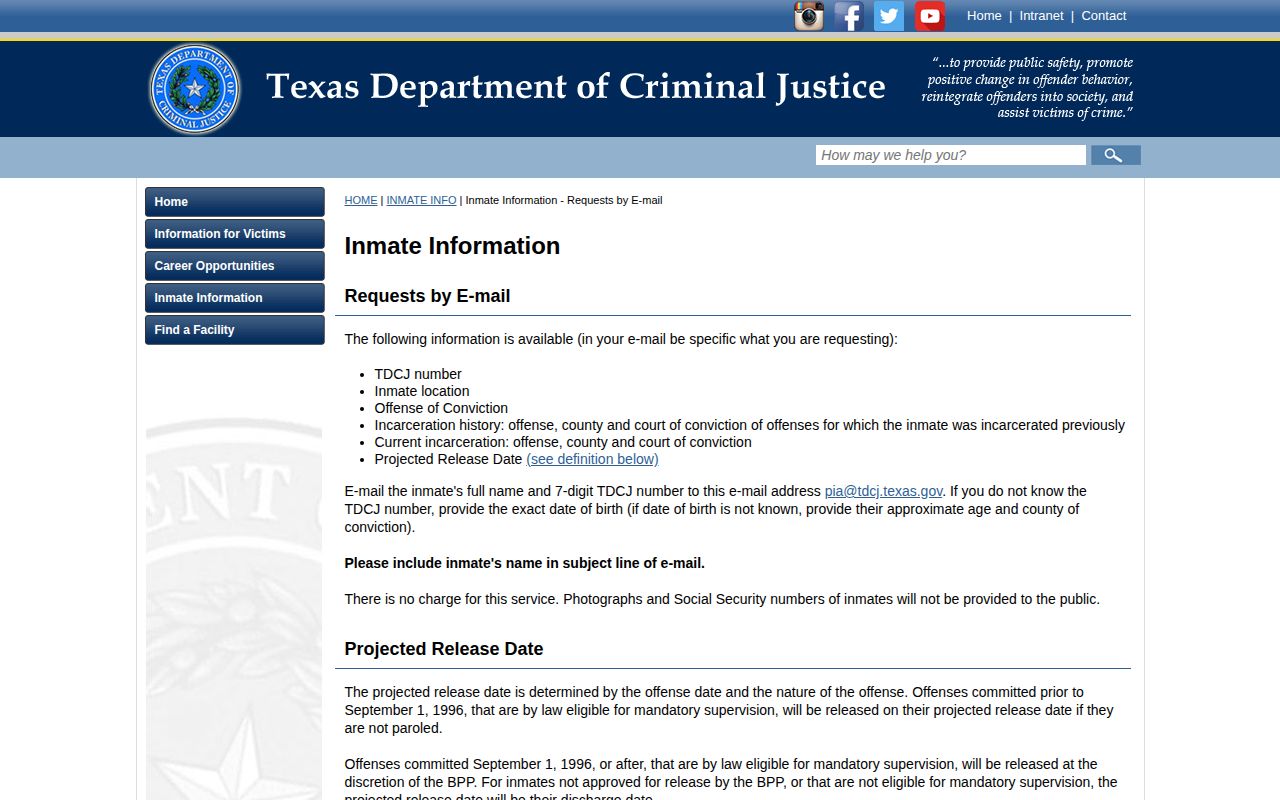
The page is especially useful after the current-only online search stops returning a historical incarceration.
Texas Good Time Rules
Texas Government Code Chapter 498 governs TDCJ good-conduct time. The credit can affect classification, parole eligibility where law permits, and mandatory-supervision calculations. It does not reduce the sentence itself. TDCJ may forfeit credit for disciplinary violations, and state law controls whether a category of prisoner can use credit toward a form of release.
There is no sound statewide claim that every Texas prisoner must serve “85 percent.” Government Code Section 508.145 contains offense- and sentence-specific parole eligibility rules. For serious offenses covered by subsection (d), the general threshold is actual calendar time equal to half the sentence or 30 years, whichever is less, with a two-year minimum. Good time does not reduce that calendar threshold. Other offenses and sentence types follow other rules. Eligibility allows review; it does not compel parole.
Mandatory supervision also has statutory limits under Government Code Sections 508.147 through 508.149. Some cases are excluded, and discretionary review can apply. A person may also reach a maximum sentence date without receiving parole. The safe method is to read the official TDCJ fields and ask a sentence specialist about disputed calculations rather than applying a broad percentage to a sentence.
Changes to Bosque Release Dates
A projected date moves because the facts or legal status used in the computation change. Some changes arise within TDCJ. Others come from a court or another agency. The reason should be traced to an official entry.
| Factor | Possible effect |
|---|---|
| Good-time forfeiture | Loss of credit can change eligibility or mandatory-supervision calculations. |
| Detainer or hold | Another agency may take custody even when the current term permits release. |
| Court order | A corrected judgment, new sentence, appeal ruling, or credit finding can alter the record. |
| Parole vote | Approval may set a future date or conditions; denial can set a later review. |
| Required program | An approval may depend on completing treatment or another stated condition. |
| Release-plan review | TDCJ must verify the plan and prepare a certificate before an approved release. |
A transfer does not equal community release. Someone leaving Bosque County Jail for TDCJ may take time to appear after intake. Likewise, a person leaving TDCJ under parole or mandatory supervision remains under legal supervision, while discharge means the sentence or supervision obligation has ended.
When a hold appears, identify the agency that lodged it and ask that agency about its own custody decision. The current custodian can confirm the hold exists but may not control the next case. This is why an otherwise valid sentence-completion date can mark a handoff instead of a walk-out.
Bosque Jail Date Calculations
No official Bosque County good-time, weekend-release, or automatic date policy was found. A county sentence can involve the signed judgment, jail-credit days, concurrent or consecutive terms, outstanding holds, and the jail's actual release authorization. That makes a public date calculator unsafe. The sentencing clerk can provide the judgment, while the jail can provide the computation or release entry it maintains.
A pretrial detainee has no sentence-completion date. Release may instead depend on making bond, a personal-bond order, dismissal, another court order, or a later judgment. The sheriff's jail page says a newly arrested person is taken before a magistrate and receives an opportunity to bond, but that does not promise release within a set period. If bond is not made, custody may continue until bond or court.
For a short county term, ask whether the judgment awarded time-served credit and whether another hold prevents departure. If a response mentions transfer, request the receiving agency and transfer time. These details distinguish a true community release from movement between custodians.
Bosque Parole Release Processing
The Texas Board of Pardons and Paroles reviews parole and discretionary mandatory-supervision cases. A three-person panel votes in sequence, and two matching votes decide the result. Approval can carry a specified future date, special condition, or required program. A denial can set another review. The Board says review commonly takes about two to six months, but that range is processing context, not an individual release forecast.
After approval, TDCJ Review and Release Processing checks the plan and issues a release certificate. The pending-review line is 844-512-0461. Post-approval release status is available at 512-406-5202. Ask which step remains and whether a certificate has issued. The official release-processing page shown here explains this stage.
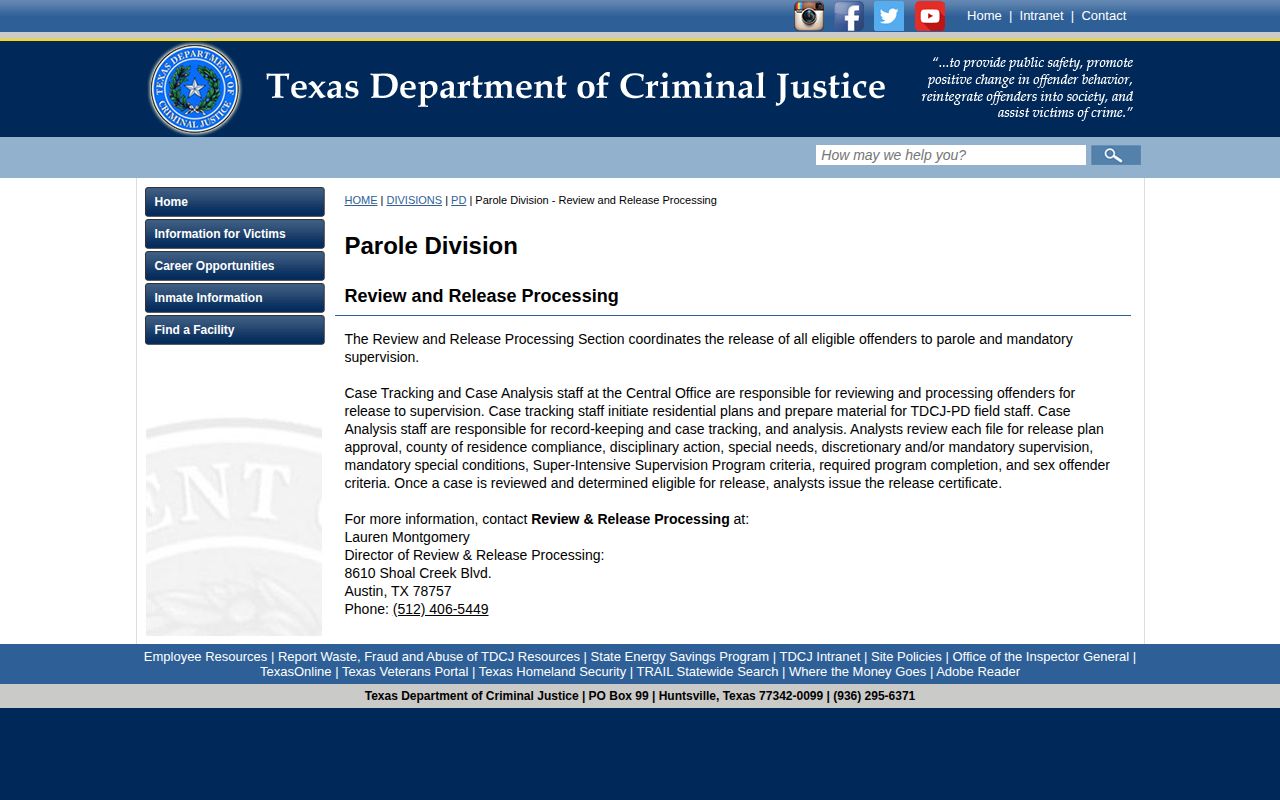
The processing page shows why an approval date and the actual walk-out date must not be treated as the same event.
A release plan may also require a verified address, reporting instructions, or a stated program before processing can finish. The public projected date does not show whether each plan item is complete. When asking about status, identify the TDCJ number and distinguish a pending panel review from an approved case in release processing. That wording helps the office route the question to the correct stage without turning an estimated date into a promise.
Confirm a Bosque Release
Use an alert as a prompt to verify, not as the final record. A Bosque County VINE inmate check may report a custody change when the supplying agency participates. For county jail release, request the sheriff's event entry. For TDCJ, keep the result, status response, and release certificate. For a federal sentence, use BOP rather than TDCJ or the county jail.
Already released or discharged people may disappear from current-custody searches. Preserve the date on each response and use a public-information request when a certified or durable record is needed. TDCJ's open-records channel can seek identifiable state records. The Bosque sheriff's records page serves the local booking route. Neither system should be asked to certify the other's release.
Public Record Search
Sponsored Results