
Bosque Release Supervision Types
Parole follows a prison sentence. It permits a person to serve part of a TDCJ sentence in the community under rules set through the Texas parole system. Mandatory supervision is another form of supervised state release created by statute. Probation, formally called community supervision in Texas, is imposed by a court instead of, or sometimes after, a jail term. Bosque Adult Probation handles local adult community-supervision routing. The TDCJ Parole Division handles state parole and mandatory supervision.
A jail release record may say that someone left on a court order, but it does not by itself prove parole. Likewise, a TDCJ parole record does not show that a Bosque court placed someone on probation. Start with the judgment and custody system that produced the release.
| Record type | Who orders it | Where to verify |
|---|---|---|
| Parole | Texas Board of Pardons and Paroles after a TDCJ sentence | TDCJ inmate information, release processing, Parole Division |
| Mandatory supervision | Texas law and Board review where required | TDCJ release and supervision records |
| Probation | Sentencing court | Court judgment and Bosque Adult Probation |
| Discharge | Completion or formal end of the sentence or supervision | Issuing agency's discharge record and court record |
- Parole
- Conditional community release before a prison sentence reaches its maximum end date.
- Probation
- Court-ordered community supervision tied to a criminal judgment.
- Absconder
- A person alleged to have stopped reporting or left supervision without permission.
- Discharge
- The formal end of a sentence or supervision duty, not merely release from a building.
Verify Bosque Post-Release Supervision
No single Bosque County public search combines parole and probation. The correct path depends on the judgment. TDCJ's online search is limited to people currently incarcerated in a TDCJ facility, so an already released person may require an email, telephone, or public-information request. Bosque Adult Probation posts an office contact but no public supervisee database.
- Find the sentencing court and case number. Read the judgment for a probation term, prison sentence, or jail sentence.
- For a TDCJ case, check the official inmate search while the person is still incarcerated. Note the TDCJ or SID number and parole-review fields.
- If the person has left TDCJ custody, use TDCJ inmate information by email or call the official information lines. Ask for release and current-status facts using strong identifiers.
- For probation, contact the sentencing clerk and compare the judgment with the Bosque Adult Probation office record. The local office does not promise public disclosure of a person's supervision status.
- Confirm the assigned field office. The Waco District Parole Office is a nearby route, but the directory does not establish that it handles every Bosque case.
A parole approval, jail release, and discharge are different events. Match the status to its official record before drawing a conclusion.
Bosque Probation Office Hours
The Bosque County Adult Probation office is the local contact for court-ordered adult community supervision. It sits in Meridian and has shorter Friday hours. Staff can route questions about a judgment or an assigned officer, subject to confidentiality and office policy. The posted page does not offer a name search or guarantee that staff will confirm an individual's status.
Bosque County Adult Probation
201 South Main
Meridian, TX 76665
Phone: 254-435-6311
Fax: 254-435-2709
Monday through Thursday: 8 a.m. to 5 p.m.
Friday: 8 a.m. to noon
Those Friday hours matter when a court deadline or reporting question arises near the weekend. Call before traveling. A probation office contact is not a substitute for the signed judgment, and it should not be treated as a general public directory of supervised people.
Bosque Release Conditions and Violations
Conditions vary by case. They may include reporting, travel limits, program participation, fees, testing, or other terms in the judgment or release certificate. Only that document and the supervising office establish the actual rules. An allegation that a person broke a condition does not itself show the outcome. The court or parole process may investigate, modify conditions, continue supervision, issue a warrant, or begin revocation proceedings.
Revocation means a formal process that may end community supervision and return a person to custody. It is not the same as an initial parole review. Texas parole supervision records also have confidentiality limits under Government Code Chapter 508, so a general public request may not yield a full case file. Ask for an identifiable existing record and let the agency state what can be released.
Bosque Supervision Warrant Checks
Bosque County has no verified online county warrant or absconder list. The sheriff's published warrant procedure requires a person to appear in person with valid identification. It also says warrant information is not released by telephone. That local rule must stay separate from TDCJ parole warrants and revocation records.
A current-custody search may show that someone has been booked after a warrant was served, but absence from a roster does not clear a warrant. Do not infer an all-clear from a search result. Follow the sheriff's in-person instructions for county warrant questions and TDCJ channels for state parole matters.
Note: A local probation allegation and a state parole warrant arise from different authorities, even when both involve the same Bosque County person.
Bosque Parole Review Records
The Texas Board of Pardons and Paroles does not conduct formal public hearings for individual parole or mandatory-supervision consideration. Panel members review case files and vote. Public board meetings are not a calendar of named inmate decisions. TDCJ identifies cases before eligibility, an Institutional Parole Officer prepares a summary, and a three-person panel votes in sequence. Two matching votes decide the result.
The official review description says the process commonly takes about two to six months. That range is not a release promise. Approval may carry a future date, a treatment condition, or a release-plan requirement. A denial may set a later review date. The Board's vote options explain the codes without reducing every result to a simple same-day yes or no.
For a pending review, TDCJ lists 844-512-0461. After a favorable vote, release-processing status is available at 512-406-5202. The latter step matters because TDCJ must review the plan and issue the release certificate before physical release.
The official parole review screen is documented in the source image below. The TDCJ parole review page supplies the process shown.
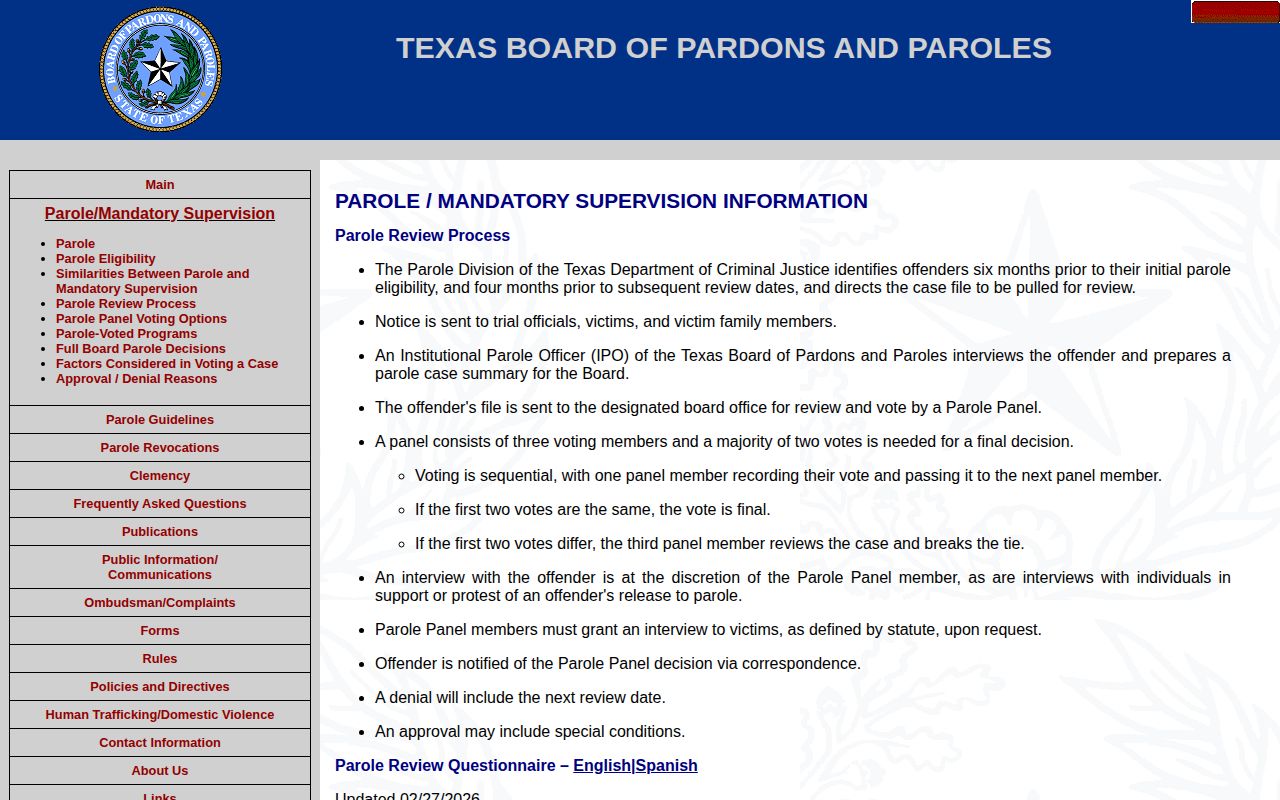
The page describes statewide review mechanics, not a Bosque County hearing date or final release certificate.
Eligibility and projected release are also distinct. Government Code Section 508.145 sets offense-specific parole eligibility rules. For serious-offense cases within subsection (d), the general threshold uses actual calendar time equal to half the sentence or thirty years, whichever is less, with a two-year minimum. Good-conduct credit does not cut that calendar threshold. Other statutes and offense categories use other rules. Eligibility only allows review. It does not command approval, fix a public hearing day, or establish the day someone will leave a unit.
Bosque Release Alerts and Registries
VINELink may provide custody-change alerts when the reporting agency participates and supplies the event. Coverage and timing must be checked in the live Texas portal. An alert can help a registered person learn that custody changed, but it is not a certified parole or probation record. Keep the sheriff, TDCJ, or court route as the proof source.
The Texas DPS Sex Offender Registry is narrower. It covers only people with a legal registration duty. A registry entry is not a list of all released people, all parolees, or all probationers. Conversely, absence from that registry says nothing about ordinary supervision.
TDCJ's Integrated Victim Services System serves a different role from a public supervision lookup. Eligible registrants may receive notices tied to a state case. That service should not be used to infer facts it does not display, and its notices do not replace the release certificate, judgment, or assigned-office record. For one Bosque County person, compare the notice with the originating agency's dated status.
Bosque Supervision Discharge Records
Supervision ends through a documented discharge, court action, sentence expiration, or other official event. Release from the jail is not enough. For probation, obtain the original judgment and later court entries that show completion, early termination, revocation, or another result. For parole or mandatory supervision, seek the TDCJ discharge or release record and reconcile it with the maximum sentence date.
The Bosque County released-inmate search and records path explains how the sheriff's release entry, court disposition, and state record fit together. Each answers a different question. A jail record establishes that county processing ended or a transfer occurred. A court record explains the legal order. A TDCJ record establishes the state-custody and supervision event.
Texas Government Code Chapter 552 governs requests for public information, but other laws may make specific supervision material confidential. A focused request for an existing release certificate, discharge date, or identifiable court order is more useful than asking an agency to research a person's whole history. If a record is withheld, the custodian should identify the applicable process or exception.
A maximum sentence date can pass after a period of parole supervision, while a probation case can end through a separate court order. Preserve the source, record date, and case identifiers when comparing them. A same-name match is not enough. TDCJ number, SID number, birth details, county of conviction, and cause number help distinguish records without guessing. When two official sources conflict, ask the record holders to reconcile the difference rather than selecting the result that seems newest.